
Yoga nidra, often translated as "yogic sleep", is a guided practice done lying down that takes you to the threshold between waking and sleep while you remain aware. You do not move, you do not concentrate, and you do not try to relax; a voice (or your own memory) leads attention through the body, the breath, and a few images, and the nervous system settles on its own. A session lasts 10 to 40 minutes. It is the most restful practice we teach, and the one people ask for again the moment it ends.
I teach yoga nidra at every retreat we run in Alberta, usually after lunch or at the end of the day, and I use it myself on nights when sleep does not come. This guide explains what yoga nidra is, where it comes from, what the eight stages do, how to practise it without a recording, and what the research actually shows.
What Is Yoga Nidra?
The name is Sanskrit: yoga (union) and nidra (sleep). The phrase is old and appears in texts as a state of consciousness; the practice most people mean today is much younger. In the 1960s and 70s, Swami Satyananda Saraswati of the Bihar School of Yoga took elements of tantric nyasa (placing awareness on parts of the body) and built a fixed, teachable sequence. That sequence, published in his book Yoga Nidra in 1976, is what studios, apps, and retreat centres around the world use now, with variations.
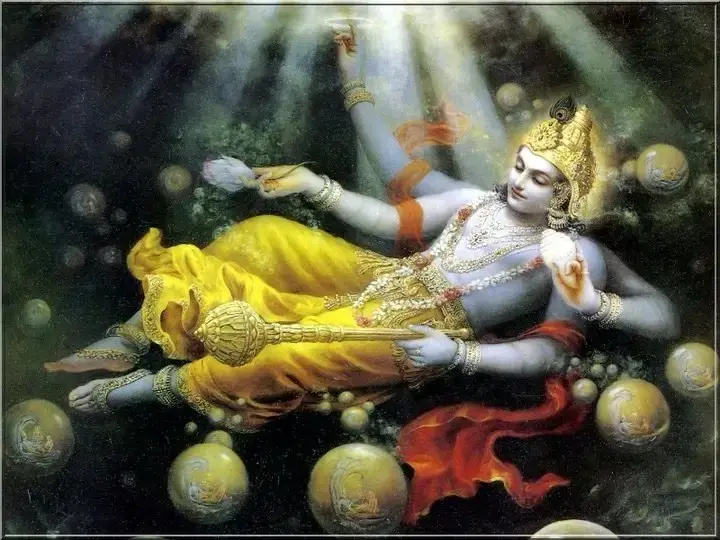
What makes yoga nidra different from ordinary relaxation is the state it aims at. Awake, the brain runs mostly on fast beta waves. Asleep, it drops through theta into slow delta. Yoga nidra parks you in the narrow band in between, the hypnagogic state, where the body is as still as in deep sleep but a thread of awareness remains. Most people know this state from the seconds before falling asleep. Yoga nidra makes it last for twenty minutes.
Yoga nidra vs. meditation vs. NSDR
Meditation, in the sense we teach at Vipassana retreats, is sitting upright and training attention: you return to the breath, note what arises, and stay awake. It builds a skill. Yoga nidra is lying down and being led; attention follows the voice, effort is close to zero, and drowsiness is allowed. It gives rest. NSDR (non-sleep deep rest) is a term coined by the Stanford neuroscientist Andrew Huberman for the same family of practices, stripped of the Sanskrit and the sankalpa. If you have used an NSDR recording, you have done a form of yoga nidra. iRest is a clinical adaptation by Richard Miller used with veterans and in pain programmes.
The distinction that matters: meditation is the training, yoga nidra is the recovery. They belong together, which is why we schedule yoga nidra after the hardest sitting sessions of the day.
The 8 Stages of Yoga Nidra
Every yoga nidra follows the same architecture. Knowing it is what lets you practise without a recording.
| Stage | What happens | Time |
|---|---|---|
| 1. Preparation | Savasana, blanket, eyes closed, "I will stay awake" | 2–3 min |
| 2. Sankalpa | A short resolve, repeated three times | 1 min |
| 3. Rotation of consciousness | Attention moved through the body in a fixed order | 8–12 min |
| 4. Breath awareness | Counting breaths backward, e.g. from 27 | 3–5 min |
| 5. Opposites | Heaviness/lightness, heat/cold, pain/pleasure | 3–5 min |
| 6. Visualisation | Simple images or a short journey | 3–5 min |
| 7. Sankalpa | The same resolve, repeated three times | 1 min |
| 8. Externalisation | Return: breath, sounds, room, small movements | 2–3 min |
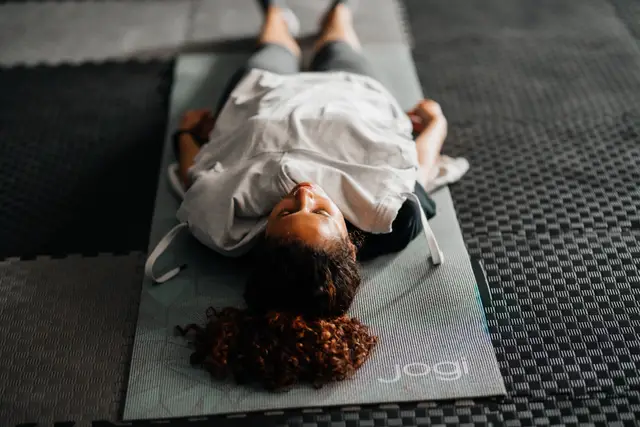
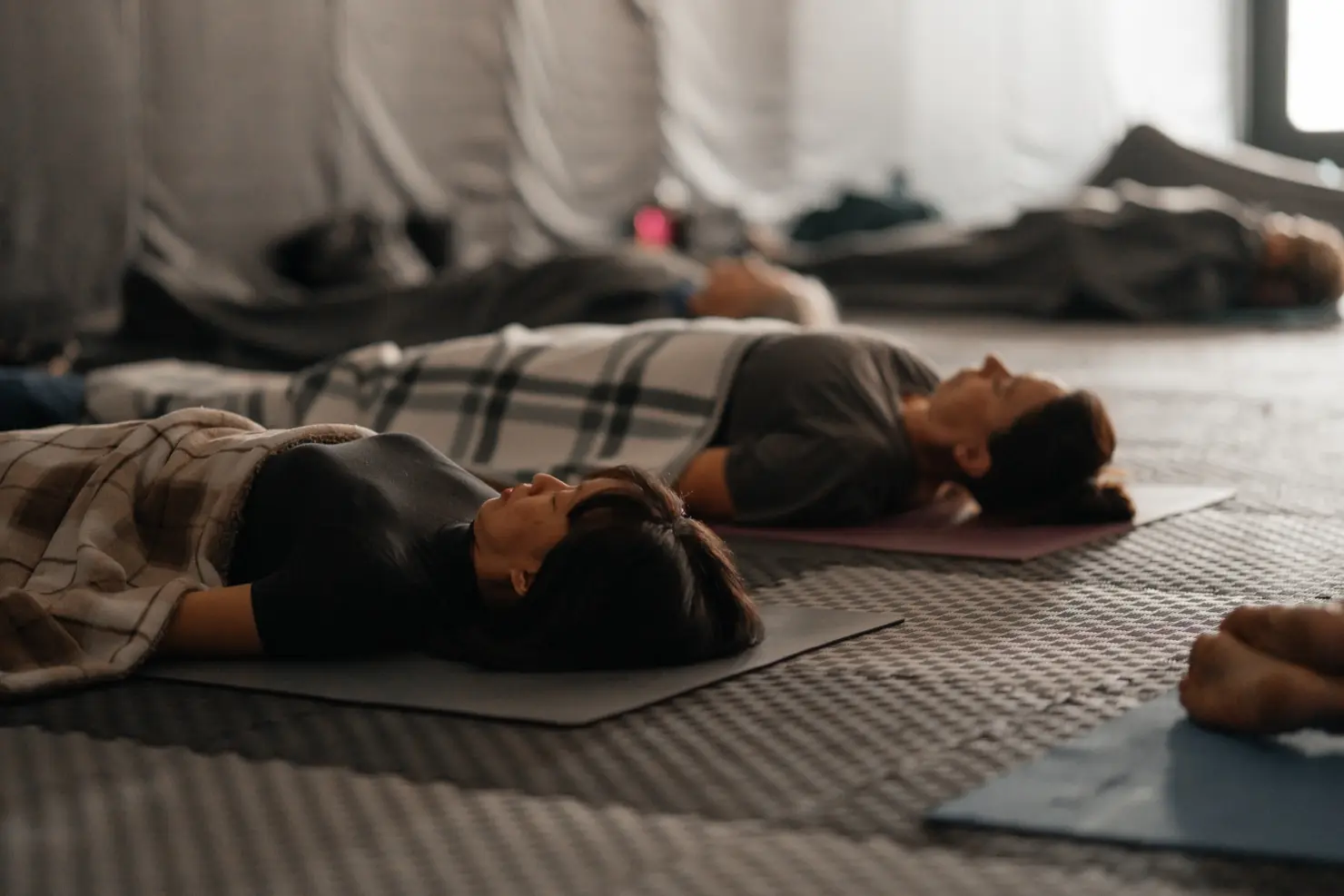
1. Preparation. Lie on your back in savasana: legs slightly apart, arms a little away from the body, palms up, something under the knees if the lower back asks for it, a blanket over you because body temperature drops. Eyes close. The teacher says the line that defines the practice: "You are going to practise yoga nidra. Do not sleep. Stay aware."
2. Sankalpa. A sankalpa is a short, positive resolve in the present tense: I am calm and steady. I am at peace. I am healthy. Choose one and keep it for months. It is planted now, at the door of deep relaxation, and repeated at the end, when the mind is most receptive. Satyananda considered this the most important part of the practice; most modern recordings drop it. We keep it.
3. Rotation of consciousness. This is the core. Attention is moved rapidly through the body in a fixed sequence: right hand thumb, second finger, third, fourth, fifth, palm, back of the hand, wrist, elbow, shoulder, armpit, waist, hip, thigh, knee, calf, ankle, heel, sole, toes; then the left side; then the back of the body; then the front; then the whole body. You do not move the parts or tense them, and you do not try to relax them. You simply hear the name and feel the place. The speed is deliberate: fast enough that the thinking mind cannot keep up and comment, slow enough to actually land. By the end of the rotation, most people are already at the threshold.
4. Breath awareness. Attention comes to the natural breath, usually at the navel or the nostrils, and you count backward: 27 breathing in, 27 breathing out, 26 breathing in… If you lose count, start at 27 again. The counting keeps the thread of awareness alive at exactly the point where the body wants to fall asleep.
5. Opposites. The teacher evokes pairs of sensations: heaviness, then lightness; heat, then cold; sometimes pain, then pleasure. The body is asked to feel each fully. This stage trains the nervous system to move between states without resisting either, which is the same capacity that lets you stay steady when life brings its own opposites.
6. Visualisation. Short, simple images: a candle flame, a mountain, the sea, a still lake. In the traditional form there is a rapid series; in ours there are few. The images should not be worked at; they arise, or they do not, and either is fine.
7. Sankalpa. The same resolve, three times, with feeling.
8. Externalisation. Awareness widens: the breath, the weight of the body on the floor, sounds in the room, then beyond it. Small movements in the fingers and toes. Rolling to one side. Sitting up slowly. The return should take at least two minutes; rushing it wastes the practice.
How to Do Yoga Nidra Without a Recording
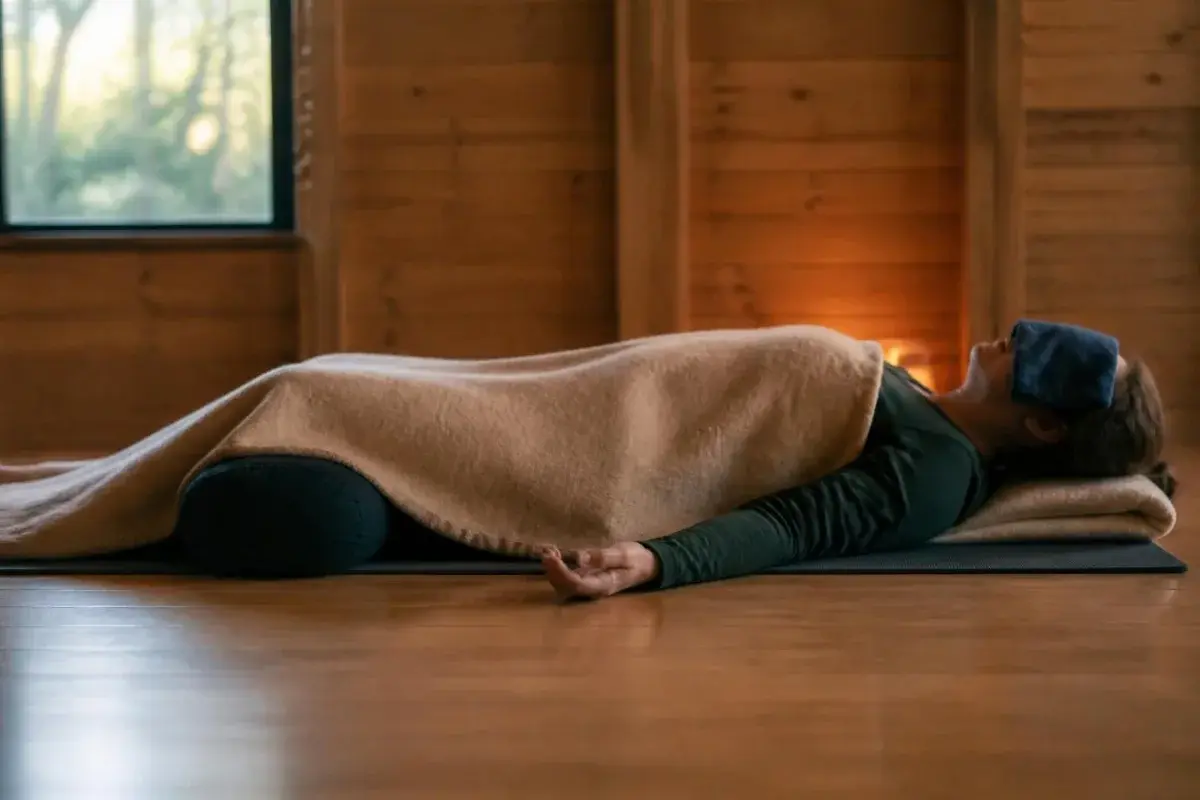
Most people learn yoga nidra from recordings and then depend on them, which fails at exactly the moment it matters most, at 3 a.m. with the phone in another room. The alternative is to learn the sequence once and guide yourself silently. Here is a 15-minute version you can memorise in a few evenings.
Set-up (2 min). Lie down. Blanket on. Something over the eyes if there is any light. Tell yourself: I am practising yoga nidra. I will stay aware. Take three slow breaths with long exhales.
Sankalpa (30 sec). Your resolve, three times, silently.
Rotation (6–8 min). Right side: thumb, each finger, palm, wrist, forearm, elbow, upper arm, shoulder, armpit, side of the chest, waist, hip, thigh, knee, shin, ankle, heel, sole, each toe. Left side, the same. Then: back of the head, back of the neck, upper back, lower back, buttocks, backs of the legs, heels. Then: forehead, eyes, cheeks, jaw, throat, chest, belly, pelvis, fronts of the legs, feet. Then the whole right side, the whole left side, the whole body.
Breath (3 min). Count backward from 27 with each full breath. If the count goes, begin again at 27 without comment.
Opposites (2 min). The whole body heavy, sinking into the floor. Then the whole body light, as if floating. Then warm. Then cool.
Sankalpa (30 sec). Three times.
Return (2 min). Breath, weight, sounds, room. Fingers, toes. Roll to the right. Sit up. Or, if this is bedtime, skip the return and let sleep take over wherever it wants.
Two practical notes. The rotation does not need to be perfect; what matters is the rhythm and that you keep moving. And if you fall asleep in the middle, you have not failed: at night, that is the point, and in the day it usually means you are short of sleep, not short of practice.
Yoga Nidra for Sleep
Yoga nidra is the strongest tool I know for two sleep problems that ordinary relaxation does not touch: the tired-but-wired night, when the body is exhausted and the mind will not stop, and waking at 3 a.m. and being unable to go back down.
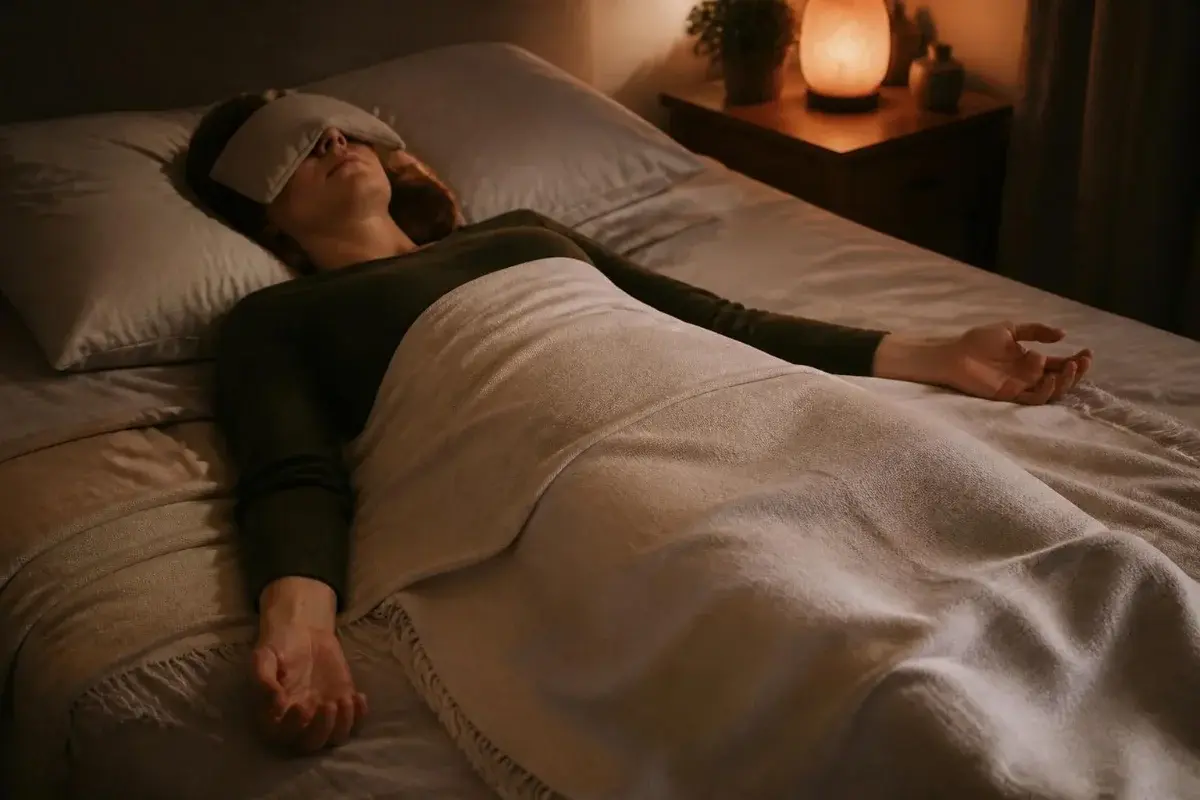
The reason is the state it produces. Yoga nidra does not ask you to fall asleep; it asks you to rest at the threshold. That removes the demand, and the demand ("I must sleep, I have work at seven") is what keeps most people awake. Rest arrives, and sleep usually follows it through the side door. If sleep does not come, you have still had twenty minutes of deep rest, which is a different night from twenty minutes of clock-watching.
For bedtime, do the sequence above and skip the return. For waking in the night, do not check the time; lie on your back, start the rotation from the right thumb, and let it carry you. Our full guide to meditation for sleep puts yoga nidra alongside four other techniques and a 10-minute bedtime routine.
Yoga nidra for sleep and anxiety
When anxiety is the driver, two adjustments. Begin the rotation with points of contact rather than the fingertips: the weight of the heels, the backs of the legs, the shoulder blades, the back of the head on the pillow. Contact is grounding in a way the extremities are not. And keep the eyes covered; anxious nervous systems settle faster in complete dark. If anxiety at night is frequent and severe, yoga nidra is a support, not a treatment; a doctor or therapist should be part of the picture.
Benefits of Yoga Nidra: What the Research Shows
Yoga nidra has a smaller research base than seated mindfulness, but what exists is consistent and some of it is striking.
In 2002, Kjaer and colleagues at Copenhagen University used PET scans to measure dopamine release in experienced practitioners during yoga nidra. They recorded a 65% increase in endogenous dopamine in the ventral striatum, together with reduced readiness for action: the brain was awake, pleasantly, and doing nothing. It remains one of the few direct measurements of what a meditative state does to neurotransmitters.
In 2020, Moszeik, von Oertzen and Renner published a randomised trial in Current Psychology in which several hundred adults practised an 11-minute online yoga nidra daily for 30 days. Compared with a waiting-list group, the practice group reported lower stress, better wellbeing, and better sleep quality, and most of the gains were visible within the first two weeks. Eleven minutes a day is a low bar, and the study is a large part of why yoga nidra spread so fast during the pandemic under the NSDR label.
Smaller clinical studies have reported improvements in chronic insomnia, in anxiety and depression scores among students, and in menstrual and hormonal symptoms. These are promising rather than conclusive. What I can add from the room is the same thing every teacher of this practice reports: people come out of yoga nidra looking like they have slept for hours, and their next seated meditation is deeper.
The benefits people actually notice, in order of how often we hear them: falling asleep faster that night, a quieter mind for the rest of the day, less physical tension, a lift in mood, and, for regular practitioners, a slow change in how they meet stress, which is where the sankalpa does its work.
Who Should Be Cautious
Yoga nidra is one of the safest practices there is: you are lying still under a blanket. A few notes. If you have a history of trauma, deep relaxation can occasionally surface difficult material; practise with a teacher who knows how to adapt the rotation, keep the eyes open if you need to, and skip the opposites stage. If you have severe depression, some teachers advise sitting rather than lying, to avoid sinking. If you are pregnant, lie on your left side with support rather than flat on your back after the first trimester. And do not drive straight after a session; give yourself ten minutes. That is the whole list.
Yoga Nidra in Calgary: Classes and Retreats
The first standalone yoga nidra session we are running is in Calgary on Saturday, October 24, 2026, at 7:00 PM: Yoga Nidra: Deep Trance Journey, a guided evening practice in the full Satyananda form, about 90 minutes including set-up and a slow return, at 489 Sienna Park Drive SW. The fee is $50, and mats, blankets, and bolsters are provided. Details and registration are on the yoga nidra in Calgary page.
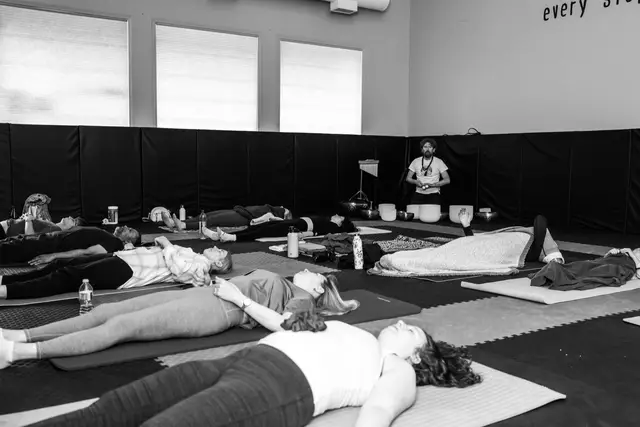
Every retreat we run in Alberta also includes yoga nidra, and it is placed deliberately. At the one-day retreat in Calgary and Edmonton it comes in the afternoon, between the deep meditation and the sound journey, when the body has been sitting for hours and needs to be horizontal. At the three-day silent retreat at Mount St. Francis it closes the afternoon session on each day, and by the second day people are asleep before the rotation reaches the left foot, which is fine. Learning it in a room, with a teacher's voice, is the fastest way to get the sequence into memory; after that, it is yours.
Frequently Asked Questions
What happens in yoga nidra?
You lie still, eyes closed, and a teacher guides your attention through eight stages: preparation, a resolve (sankalpa), a rotation of attention through the body, breath counting, pairs of opposite sensations, simple visualisation, the resolve again, and a slow return. The body reaches the stillness of deep sleep while a thread of awareness stays awake.
What is the difference between yoga nidra and meditation?
Meditation is done sitting upright and trains attention; you stay alert and return to an object such as the breath. Yoga nidra is done lying down and is guided; attention follows the voice, effort is minimal, and drowsiness is allowed. Meditation builds the skill; yoga nidra gives the rest. We teach both and schedule yoga nidra after the hardest sitting sessions.
Is yoga nidra the same as NSDR?
Essentially, yes. NSDR (non-sleep deep rest) is a term Andrew Huberman coined for yoga nidra-style practices without the yogic vocabulary and usually without the sankalpa. The body rotation, breath awareness, and threshold-of-sleep state are the same.
Who should not do yoga nidra?
Almost no one is excluded. People with a trauma history should practise with a teacher who can adapt the rotation and skip the opposites; people with severe depression may do better sitting than lying; pregnant practitioners should lie on the left side with support after the first trimester. Do not drive immediately after a session.
What happens if you do yoga nidra every day?
In the 2020 trial by Moszeik and colleagues, 30 days of an 11-minute daily practice lowered stress and improved sleep and wellbeing, with most of the change in the first two weeks. Daily practitioners commonly report falling asleep faster, less physical tension, and a steadier mood. There are no known negative effects of daily practice.
How long should yoga nidra be?
Ten to fifteen minutes is enough for a daily reset or for bedtime; twenty to forty minutes is the traditional full practice and what we do at retreats. Longer is not better if it means you skip it. The 11-minute practice in the 2020 study was long enough to produce measurable results.
Can I do yoga nidra in bed?
Yes. For sleep, bed is the right place: do the sequence and skip the return. For daytime practice, the floor is better, because the bed tells the body to sleep and you are trying to stay at the threshold.
Artem Rusinov
Founder & lead instructor · Vipassana.ca
Artem is a certified yoga instructor and a member of the International Yoga Federation and Yoga Alliance. He trained in music before coming to meditation, and leads the yoga, meditation and sound healing sessions at Vipassana.ca’s one-day and three-day retreats in Calgary and Edmonton.
- Saraswati, Swami Satyananda. Yoga Nidra. Bihar School of Yoga, Munger, 1976 (6th ed. 1998).
- Kjaer TW, Bertelsen C, Piccini P, Brooks D, Alving J, Lou HC. Increased dopamine tone during meditation-induced change of consciousness. Cognitive Brain Research. 2002;13(2):255–259. doi:10.1016/S0926-6410(01)00106-900106-9)
- Moszeik EN, von Oertzen T, Renner KH. Effectiveness of a short Yoga Nidra meditation on stress, sleep, and well-being in a large and diverse sample. Current Psychology. 2022;41:5272–5286 (published online 2020). doi:10.1007/s12144-020-01042-2