Goenka Vipassana Retreat: 10-Day Course, Cost & Alternatives

If you’ve typed “Goenka Vipassana” into Google, you’ve probably already heard the stories. Ten days of complete silence. No phone, no books, no eye contact. Waking up at 4 a.m. to a gong. Someone’s cousin who came back “a different person,” or the coworker who left on day six.
Every year, tens of thousands of people around the world sit a 10-day course in the tradition of S.N. Goenka. It is, by a wide margin, the most recognized form of Vipassana meditation on the planet. So recognized, in fact, that many people believe Goenka’s method is Vipassana, full stop.
It isn’t. And that’s not a criticism. It’s just something worth knowing before you commit ten days of your life to one particular doorway.
I sat a Goenka course myself before I ever taught meditation. It was one of the most demanding and valuable things I’ve done. It’s also, in large part, why Artem and I designed our own retreats the way we did. But I’ll get to that.
In this guide, I’ll walk you through what Vipassana by Goenka actually is: the man behind it, the method, the famous 10-day course, and what “free” really means when you read the fine print of a dana-based system. Then I’ll show you the wider map, because Goenka’s lineage is one of several living Vipassana traditions, and help you figure out which path actually fits your life right now.
Who Was S.N. Goenka?
Satya Narayan Goenka (1924–2013) was not a monk. He was a wealthy Burmese-Indian businessman living in Rangoon, a man running factories and battling debilitating migraines. In the 1950s, on a doctor’s recommendation of all things, he found his way to a meditation teacher named Sayagyi U Ba Khin.
That detail matters more than it sounds. U Ba Khin was himself a layman: Burma’s Accountant General, a senior government official who taught meditation in his spare time. The lineage that would become the world’s largest meditation network was built by two men with day jobs. There’s something in that. From its very root, this tradition was designed for householders, not monastics.
The U Ba Khin lineage
U Ba Khin traced his method back through Burmese teacher Saya Thetgyi to the great monk Ledi Sayadaw, who in the late 19th century began the radical work of taking Vipassana out of the monasteries and teaching it to ordinary laypeople.
Goenka trained under U Ba Khin for fourteen years. In 1969 he moved to India, carrying the technique back, as he liked to put it, to the land of its origin, and began teaching. What happened next is one of the more remarkable stories in modern contemplative history: from one man giving courses in Bombay, the movement grew into more than 200 centers and course locations worldwide, all operating under the umbrella of Dhamma.org, all teaching the exact same course in the exact same format.
Goenka died in 2013, but in a very real sense he still teaches every course. His recorded instructions and evening discourses (warm, grandfatherly, often funny) are played at every center, in dozens of languages, every single day.
“Start again. Start with a calm and quiet mind.” If you sit a Goenka course, you will hear his recorded voice say some version of this hundreds of times. Years later, many students say it’s still the voice in their head when practice gets hard.
What Is the Goenka Vipassana Meditation Method?
Strip away the schedule and the silence, and Goenka meditation rests on one core idea: everything that arises in your mind shows up in your body as sensation. Craving, aversion, anxiety, boredom. Each has a physical signature. If you can observe those sensations with equanimity, without chasing the pleasant ones or recoiling from the unpleasant ones, you gradually decondition the reactive habit patterns of the mind.
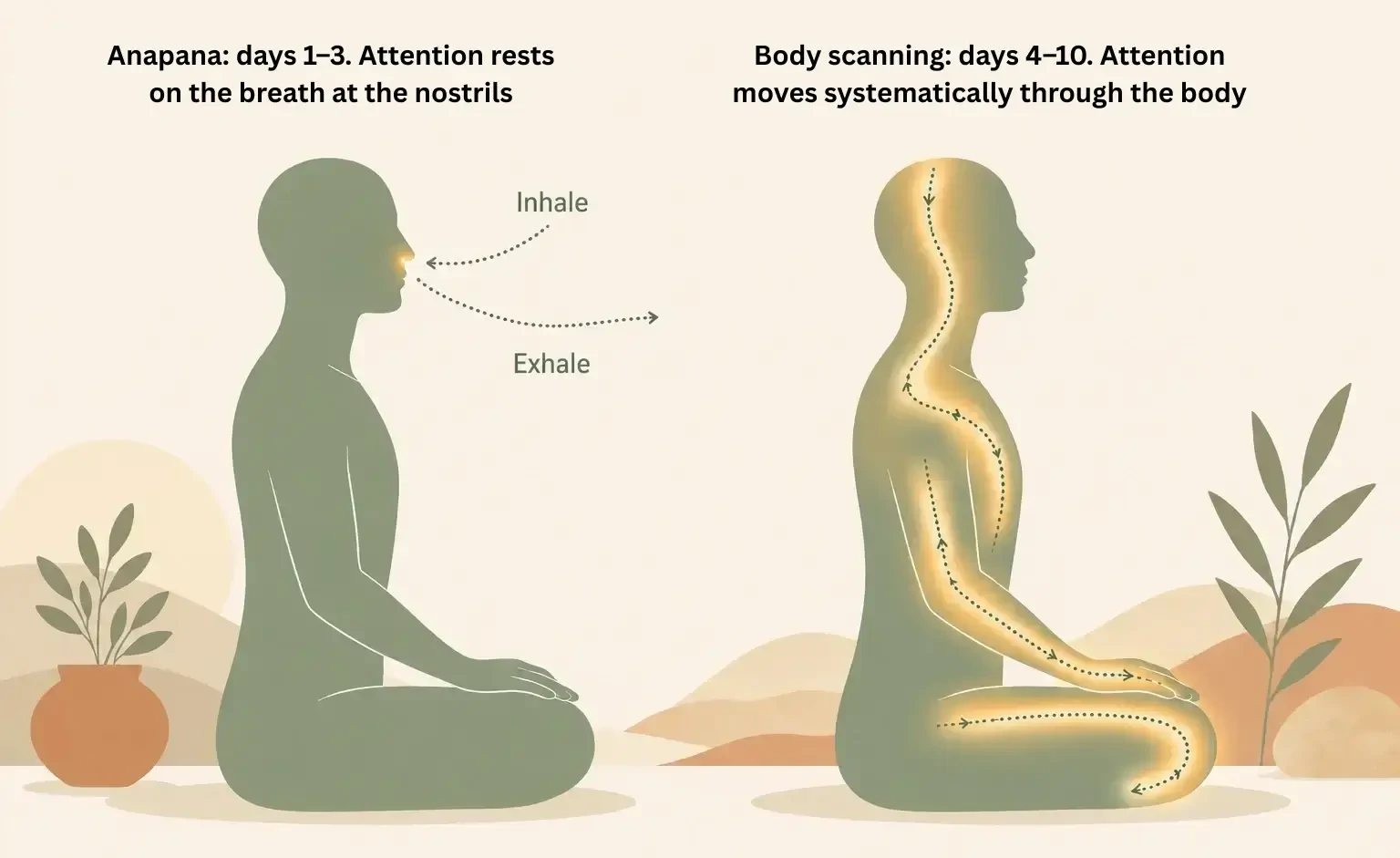
The technique for doing this is a systematic body scan: moving attention slowly through the body, part by part, simply noticing whatever sensation is present. Heat, tingling, pressure, pain, numbness, nothing at all. It’s all just sensation, and it’s all impermanent. Anicca (impermanence) is the beating heart of the method. You’re not scanning to relax; you’re scanning to verify, through direct experience, that everything changes.
Two things make Goenka Vipassana meditation distinct from almost every other meditation format you’ll encounter.
It’s completely standardized. The same audio recordings, the same daily structure, the same eleven-day arc (ten full days plus arrival day), whether you sit in India, Ontario, or Texas. There is no live teacher improvising. Assistant teachers are present to answer questions in brief scheduled interviews, but the teaching itself comes from Goenka’s recordings. Depending on who you are, this is either the method’s greatest strength or its most significant limitation. It guarantees consistency; it cannot respond to you.
It’s all sitting. There’s no formal walking meditation, no movement practice, no yoga. Roughly ten hours a day on the cushion. Your body is the laboratory, and the experiment runs long.
Here’s the thing I want you to hold onto, though: this is a Vipassana technique, one specific method within a much older and broader family. Keep that in mind; we’ll widen the lens shortly.
The Technique: Anapana, Body Scanning, and Chanting
If you sit the 10-day course, the practice unfolds in a deliberate sequence.
Anapana meditation: the first three days
The course doesn’t start with body scanning. For the first three days, you practice anapana meditation: sustained observation of the natural breath at the entrance of the nostrils. No mantra, no counting, no controlling the breath. Just watching it, feeling it, coming back when the mind wanders. Which it will. Constantly.
Anapana sounds almost insultingly simple and is anything but. Three full days of it sharpens attention to the point where you can detect subtle sensations, like the faint touch of air on the upper lip, that you’d never notice in ordinary life. It’s the whetstone for what comes next.
(If you want to try meditation before committing to any retreat, anapana is honestly the best starting point there is: sit for ten minutes and just feel your breath at the nostrils. That single instruction is a complete practice.)
Body scanning: days four through ten
On day four, “Vipassana day,” the actual technique is introduced. You begin moving your sharpened attention systematically through the body, from the top of the head to the tips of the toes and back, observing sensations with equanimity. Over the following days the instructions deepen: scanning in different patterns, sitting through the adhitthana (“strong determination”) hours without moving a muscle, learning to meet even intense pain as just another changing sensation.
The chanting and the group sittings
Two features of the course surprise people who arrive expecting pure secular technique.
- First, Goenka’s chanting. Each session opens and closes with recordings of Goenka chanting in Pali and Hindi: protective verses, blessings, passages from the Buddha’s discourses. You’re not asked to chant along or believe anything; it’s framed as creating a supportive atmosphere. Some students find it deeply moving. Others find it grates for ten straight days. Both reactions are common.
- Second, the group sittings: three one-hour sittings a day where everyone practices together in the hall. After the course, many returning students structure their home practice around the Goenka 1-hour meditation recordings, the same guided hours with long silent stretches bookended by instructions and chanting.
The Vipassana 10-Day Course: What to Expect
Now the part everyone asks about. The Vipassana 10-day course is famous for its austerity, and the reputation is earned. Here’s what you actually sign up for.
The rules. From the evening of day zero until the morning of day ten, you observe “noble silence”: no talking, no gestures, no eye contact with other students. You hand in your phone, books, and writing materials at registration. Men and women are segregated. You agree to stay for the full course and to follow five ethical precepts (no killing, stealing, lying, sexual activity, or intoxicants). Two vegetarian meals a day, with only fruit and tea after noon for new students.
The schedule. A typical day at a 10-day vipassana meditation retreat looks like this:
|
Time |
Activity |
|---|---|
|
4:00 a.m. |
Wake-up gong |
|
4:30–6:30 |
Meditation (hall or own room) |
|
6:30–8:00 |
Breakfast and rest |
|
8:00–9:00 |
Group sitting in the hall |
|
9:00–11:00 |
Meditation per teacher’s instructions |
|
11:00–1:00 |
Lunch, rest, teacher interviews |
|
1:00–2:30 |
Meditation |
|
2:30–3:30 |
Group sitting |
|
3:30–5:00 |
Meditation |
|
5:00–6:00 |
Tea break |
|
6:00–7:00 |
Group sitting |
|
7:00–8:15 |
Goenka’s evening discourse (video) |
|
8:15–9:00 |
Final sitting |
|
9:30 p.m. |
Lights out |
Add it up: roughly 10 hours of seated meditation per day for 10 days. The evening discourses, where Goenka explains the theory behind the day’s practice with stories and considerable humor, are the one part of the day most students describe as “entertainment.”
Is it hard? Yes. Day two and day six are notorious low points; ask anyone who’s sat a course. Around 4% of students leave early, and every old student knows the specific flavor of the day-two thought: “I have made a terrible mistake.” Most people who stay describe the back half of the course very differently from the front half.
Finding a 10-day course near you
In Canada, established centers include Dhamma Torana (Ontario), Dhamma Surabhi (British Columbia), and Dhamma Suttama (Quebec), plus non-center courses held at rented venues, including, periodically, in the Prairies. In the US, there are more than a dozen centers, from Massachusetts to California.
One practical reality nobody tells you: demand far exceeds supply. Courses open for registration months ahead and fill within days, sometimes hours. Waitlists of two to six months are normal, especially for women’s spots. If you search “vipassana 10 day course near me” tonight and apply tomorrow, your actual sit date is likely next season at the earliest. Factor that into your planning.
Is Goenka Vipassana Free? The Real Cost Explained
Short answer: there is no fee for a Goenka course, but “free” isn’t quite the right word either. Courses run entirely on dana (donations) from previous students. Your course is paid for by the people who sat before you; at the end, you’re invited to donate so the next person can sit. New students cannot donate more than the actual cost of their course, and nobody checks whether you donate at all.
I want to say this clearly, because we run paid retreats and I refuse to play games here: the dana model is beautiful, and it works. It has funded a global meditation network for fifty years without a price tag. Goenka insisted on it precisely so the teaching would never become a business. That deserves respect, not spin.
But if you’re budgeting a decision, here’s the honest accounting people rarely do.
- The expected donation. Nothing is required, and yet most students, moved by the experience, give something meaningful. Old students commonly donate amounts comparable to what ten days of room and board would cost. If you’re the kind of person who’d feel wrong giving nothing (most people are), plan for that.
- The time. Ten course days plus two travel days is effectively twelve days out of your life. For most working adults in Canada, that’s an entire year’s vacation allowance spent on one retreat, before family obligations enter the conversation.
- The wait. Registration opens months out and fills fast. The real “cost” of a Goenka course often includes a season of waiting.
- The travel. Centers are few and far between. Depending on where you live, add flights or long drives.
None of this is an argument against sitting a 10-day course. It’s an argument for going in with clear eyes: the vipassana 10 day course fee is $0, and the honest total cost, in time, planning, and heartfelt donation, is far from nothing.
How registration works
You apply online at Dhamma.org for a specific course, answering questions about your physical and mental health and meditation background. Applications are reviewed (some conditions require a conversation first), and you receive confirmation or a waitlist spot. If confirmed, you commit to the full ten days. Vipassana 10 day course registration is competitive enough that experienced students set calendar reminders for the moment applications open.
“The most expensive thing about a Goenka course isn’t money. It’s twelve days of your one wild and precious calendar. For many people, that’s exactly the point.
The 3-Day Vipassana Retreat: A Realistic Alternative to 10 Days
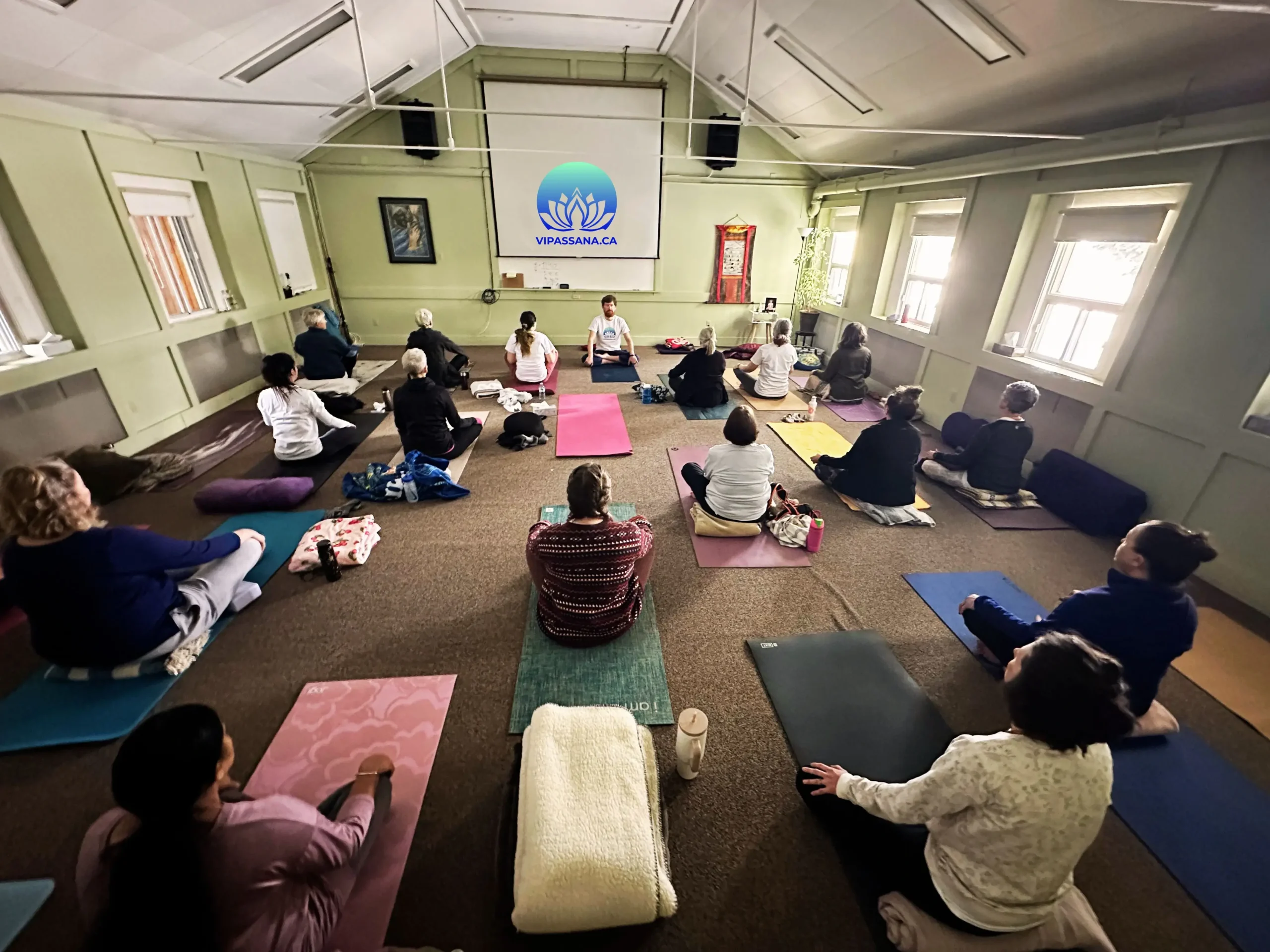
Here’s where I stop being just a guide and speak from the other side of the table.
After Artem and I had each sat our share of long retreats (Goenka courses, Mahasi-style retreats, and years of other contemplative training between us), we kept meeting the same person, again and again. Someone who wanted what a Vipassana retreat offers. Who had read about the 10-day course, maybe even applied once. And who, year after year, never went, because ten days is a wall.
A nurse with three kids does not have twelve consecutive days. A founder mid-fundraise does not have twelve days. Most people we know in Calgary and Edmonton do not have twelve days. Telling them “come back when you do” struck us as the wrong answer. So we built the retreat we wished had existed when we started: a 3 day vipassana retreat, Thursday evening to Sunday afternoon, in the forests of Alberta.
Not a lite version. A different design, built deliberately for modern working adults. Here’s the reasoning.
Three days fit an actual life. Check in Thursday evening, leave Sunday after lunch. One day off work, one long weekend. Registration is open with published dates and a transparent flat fee that covers meals and accommodation. No waitlist lottery, no season of uncertainty. You can decide in October and sit in November.
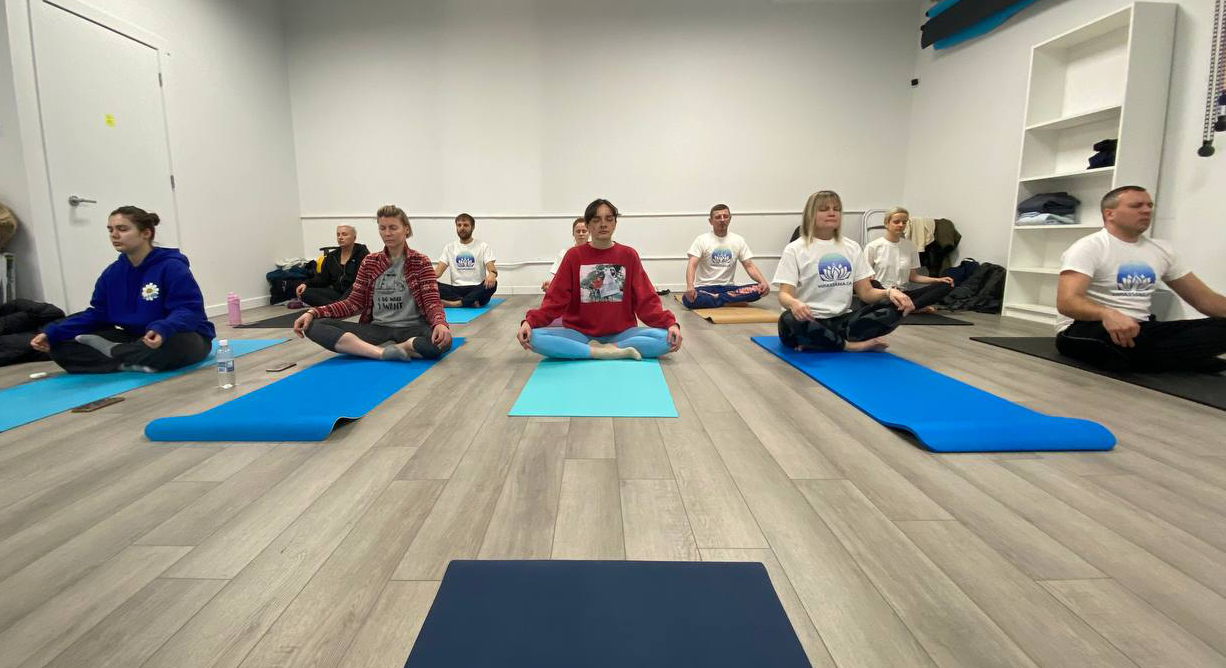
The on-ramp is humane. Instead of ten hours of sitting a day, our schedule holds 3–4 hours of formal practice daily, in shorter sessions, interspersed with yoga, walking meditation, sound healing, meals, and rest. On a Goenka course, the sheer physical endurance of sitting becomes its own obstacle; many students spend half their attention negotiating with their knees. We’d rather your attention go to the actual practice. It’s still a genuine silent retreat: noble silence, no phones, full immersion. It’s a doorway, not a test.
It’s a complete system, not a single technique. Our retreats combine three complementary practices, and the combination is the point. Vipassana meditation (in the Mahasi tradition, more on that below) trains moment-to-moment awareness. Yoga prepares the body to sit comfortably, which changes everything about meditation. Sound healing gives the nervous system a way to settle that doesn’t require effort at all. Most participants connect strongly with one or two of these and carry them home as a daily practice, usually 20–40 minutes a day. That, to us, is the real success metric: not what happens on the cushion at Gull Lake, but what you’re still doing three months later in your kitchen at 6 a.m.
There’s a live teacher in the room. The technique is taught step by step from the first session, and you can ask questions about the pain in your shoulder, the thought loop you can’t escape, the thing that came up on Saturday morning that scared you. A recording, however wise, cannot answer you back.
“We didn’t design this format because ten days is too much meditation. We designed it because ten days is too much barrier, and the people who need this practice most were the ones bouncing off it.”
— Artem Rusinov, founder of Vipassana.ca
What a silent retreat means in three days
Noble silence holds from Thursday night until Sunday: no conversation, no phones, no performing yourself for anyone. Then, on the final afternoon, the silence lifts and something we didn’t fully anticipate happens. The conversations. After three days of shared quiet, people talk to each other with an openness that’s rare anywhere else. Several participants have told us it was the most honest conversation they’d had in years. The 10-day course, where you disperse quickly after day ten, has many strengths, but this particular alchemy belongs to the small, short retreat.
Vipassana retreats near you (Canada)
If you’re searching for a vipassana retreat near me from Alberta, your realistic options are: wait for a spot at a Goenka center in BC, Ontario, or Quebec, or come sit with us. We hold retreats at Gull Lake (90 minutes from Edmonton, 2 hours from Calgary) and Mount St. Francis Retreat Centre in Cochrane (30 minutes from Calgary), both set in quiet nature, both reachable in a morning drive. Over 500 participants from Calgary, Edmonton, Red Deer, and beyond have sat with us, and many of them return.
And the honest fork in the road: if you have twelve days, a settled schedule, and the pull toward deep immersion, sit a 10-day Goenka course, sincerely. If you have a long weekend and a life that won’t pause, start with three days. Neither is the junior version of the other. They’re different doors into the same room.
Goenka Is Not the Only Vipassana: A Map of Traditions
Now let’s widen the lens, because this is the part almost every “what is Vipassana” article gets wrong or skips entirely.
Vipassana is a Pali word meaning “insight” or “clear seeing.” It’s not a brand and not one technique; it’s a family of practices within Theravada Buddhism aimed at seeing the true nature of experience directly. The practice traces to the Buddha’s teaching some 2,500 years ago, most centrally the Satipatthana Sutta, the discourse on the four foundations of mindfulness.
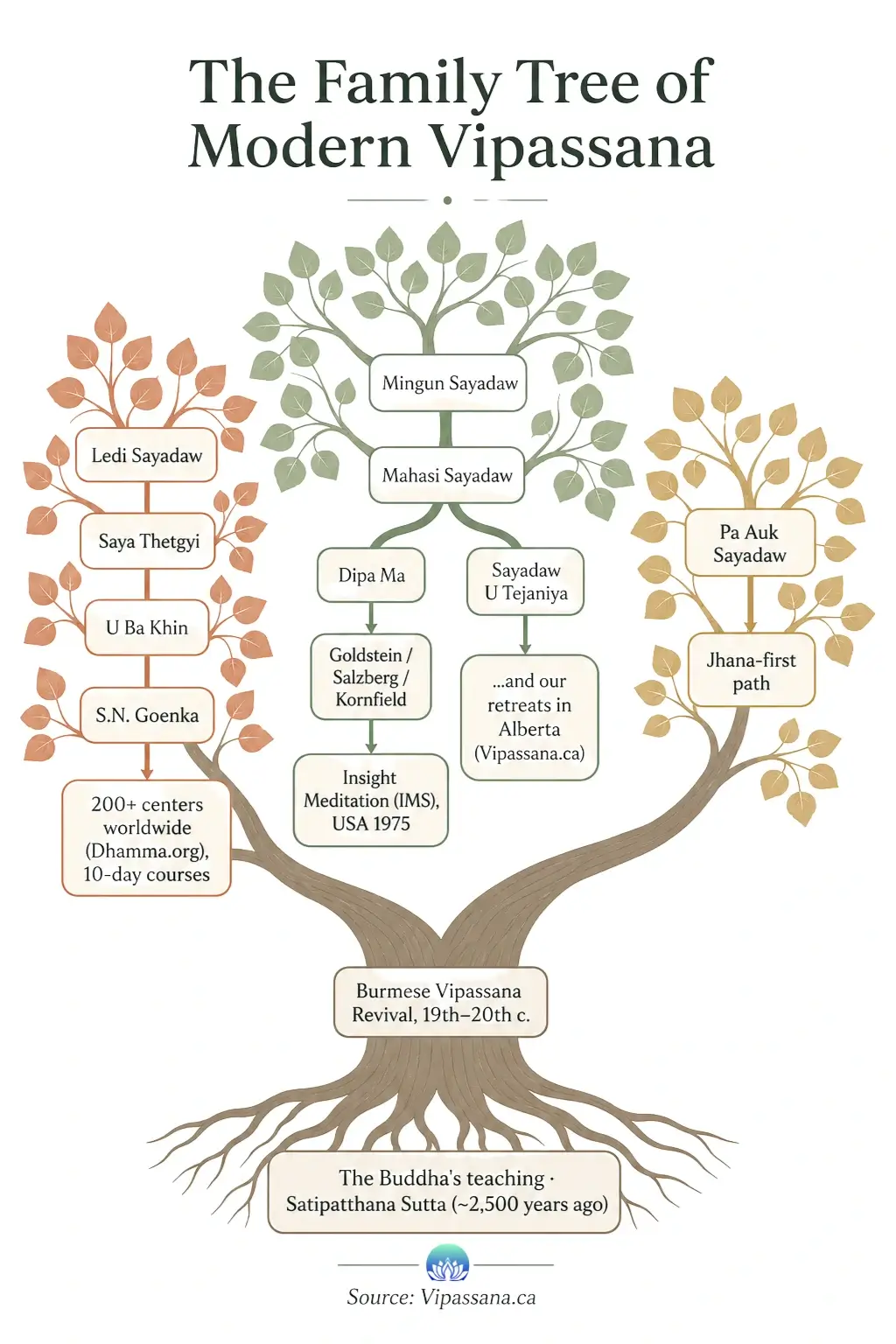
What most people don’t know: nearly everything the modern world calls Vipassana flows from the Burmese Vipassana revival of the 19th–20th centuries, when Burmese monks and teachers took meditation out of the monasteries and systematized it for laypeople. That revival produced several distinct streams.
- The Ledi Sayadaw line → Saya Thetgyi → U Ba Khin → Goenka. Body-scanning, sensation-focused. This is the 10-day course lineage.
- The Mingun Sayadaw line → Mahasi Sayadaw. Noting-based practice, alternating sitting and walking meditation, close teacher guidance. This is our lineage and, through Mahasi’s Western students, the root of much of American “insight meditation.”
- Pa Auk Sayadaw’s line, which takes the classical route: deep concentration states (jhana) first, insight after. The most monastic and technical of the modern streams.
A few honest distinctions worth having in your pocket.
Samatha vs vipassana. Samatha is concentration practice: calming and unifying the mind on a single object. Vipassana is insight practice: investigating changing experience to see its nature. Every tradition mixes them in different proportions. Goenka builds concentration through anapana then pivots to insight; Pa Auk goes deep into samatha first; Mahasi develops both simultaneously through noting.
Vipassana vs Zen. Both are Buddhist meditation; the flavor is different. Zen (a Mahayana school) emphasizes open awareness, koan inquiry, or “just sitting” (shikantaza), often with less explicit technique. Vipassana traditions tend to be more systematic and instructional. There is a method, with steps. If you’ve read Thich Nhat Hanh, you’ve tasted a third stream again: Vietnamese Zen’s gentle everyday mindfulness, which, alongside secular programs like MBSR, brought “mindfulness” into hospitals and boardrooms.
Insight meditation. In the West, the Mahasi stream largely arrived through the Insight Meditation Society (IMS), founded in 1975, which is why Americans often say “insight meditation” where Burmese would say “vipassana.”
If all you take from this section is one sentence, take this: when someone says “I did Vipassana,” they’ve told you which family of practice, not which method, which teacher, or which experience. The 10-day Goenka course is one powerful branch of a much older tree.
The Mahasi Tradition: Noting Practice
Time to properly introduce the tradition we teach, because if you’ve only heard of Goenka, the Mahasi approach will feel at once familiar and surprisingly different.
Mahasi Sayadaw (1904–1982) was a Burmese scholar-monk, one of the most learned of his era and the questioner at the Sixth Buddhist Council. His revolution was methodological: he developed a way for laypeople to practice deep insight meditation without first spending months developing absorption concentration. Intensive practice, precise technique, ordinary people. His center in Rangoon trained hundreds of thousands, and the method spread across Asia and then the world.
The noting technique
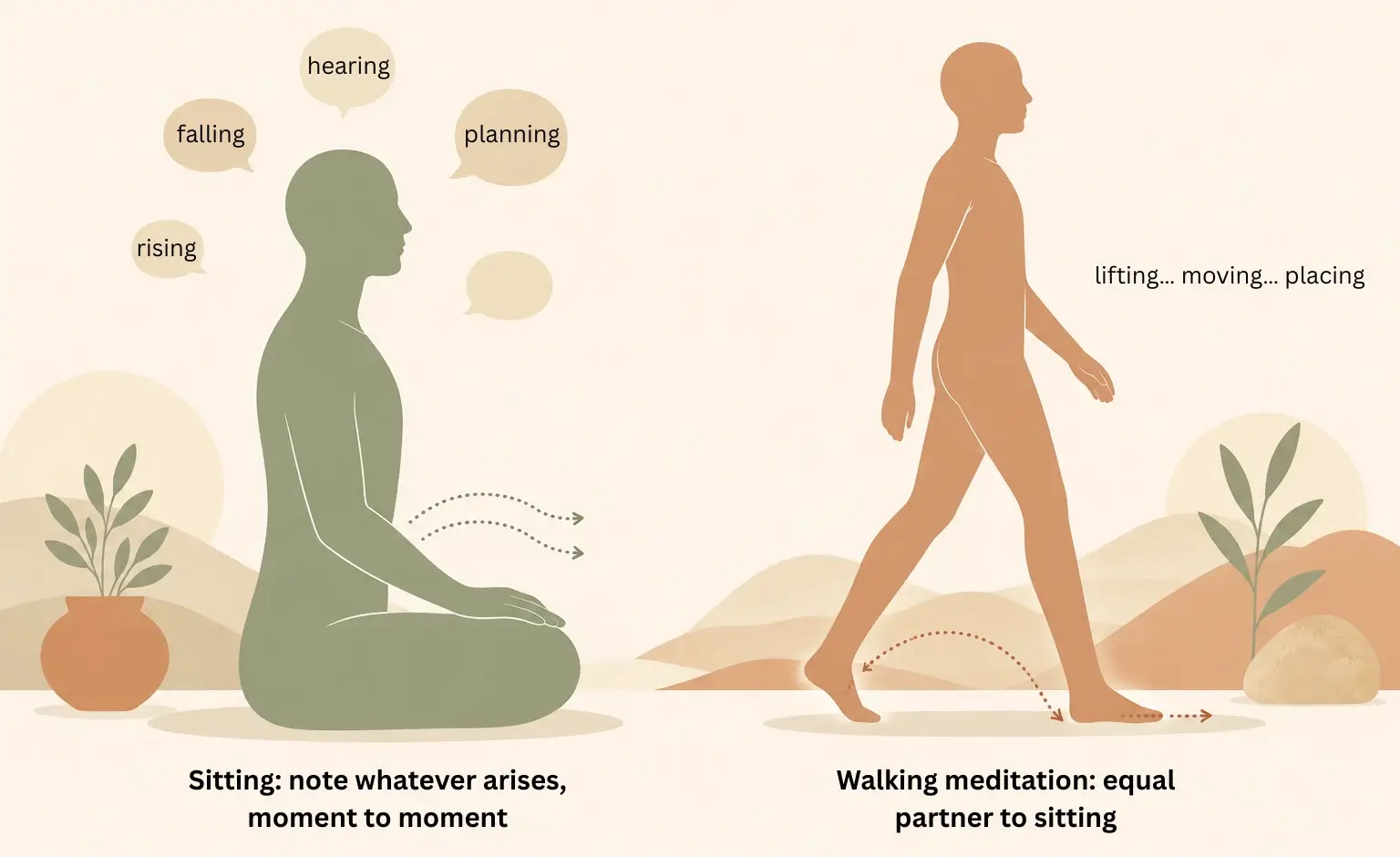
The heart of Mahasi meditation is noting: a light mental label placed on whatever is most prominent in experience, moment to moment. Sitting, you rest attention on the rising and falling of the abdomen. Rising… falling… rising… falling… When something else takes over (a sound, an itch, a plan for dinner) you note that too. Hearing… itching… planning… And you return.
That gentle label does something subtle and powerful: it converts experience from something you’re lost in to something you’re observing. The thought about dinner stops being your reality and becomes an object passing through it. Where the Goenka method uses the body-scan as its lens, Mahasi noting uses whatever arises: sensations, sounds, thoughts, emotions. This is why many people find it maps so directly onto daily life. You can note “impatience” in a checkout line. There’s no checkout line on a meditation cushion, but the practice travels.
The method alternates sitting and walking meditation in roughly equal measure. Walking slowly, you note each phase of the step: lifting… moving… placing… For bodies that seize up after multiple hours of sitting, this alternation isn’t a compromise; it’s a feature. And classically, the tradition includes regular interviews with the teacher, who adjusts instructions to what’s actually happening in your practice. Guidance is a dialogue, not a broadcast.
Satipatthana: the common root
Both traditions (all of them, really) claim the same source: the Satipatthana Sutta, the Buddha’s discourse on the four foundations of mindfulness (body, feeling-tone, mind, and mental phenomena). Goenka’s body-scan dwells deeply in the first foundation; Mahasi noting works across all four. Different emphases, same root text, same stated destination.
The lineage that came West
The Mahasi stream has a remarkable Western afterlife. Dipa Ma, a Bengali grandmother who trained in Mahasi’s tradition and became one of its most extraordinary teachers, taught a generation of young Americans in her Calcutta apartment. Among them were Joseph Goldstein and Sharon Salzberg, who co-founded the Insight Meditation Society with Jack Kornfield (himself trained in the Thai forest and Mahasi-influenced streams). If you’ve listened to almost any mainstream Western meditation teacher, you’ve heard echoes of Mahasi noting. Contemporary Burmese teachers like Sayadaw U Tejaniya continue to evolve the lineage; his relaxed, awareness-first style is quietly influencing a new generation, including how we teach.
At Vipassana.ca, our retreats follow this Mahasi Sayadaw lineage. It’s not a claim of superiority; it’s a disclosure of perspective. And it’s particularly well-suited to a 3-day format for a concrete reason: noting is precise and teachable from the very first session. You don’t need three days of anapana to sharpen attention before the real practice begins. You’re practicing insight meditation within the first hour.
Mahasi vs Goenka: Which Vipassana Path Fits You?
Having sat in both traditions, here’s my honest comparison, the one I wish someone had handed me before my first retreat.
| Goenka (U Ba Khin lineage) | Mahasi (our lineage) | |
|---|---|---|
| Core technique | Systematic body scan; sensations as the object | Noting whatever arises: breath, body, sounds, thoughts |
| Teacher contact | Recorded instructions; brief scheduled interviews with assistant teachers | Live teaching and questions from the first session |
| Movement | Sitting only (~10 hrs/day) | Sitting and walking meditation alternated |
| Format | Strictly 10 days, standardized worldwide | Flexible, from 3-day retreats to months-long intensives |
| Cost model | Dana (donation); no fee, donation expected | Transparent flat fee, meals and lodging included |
| Availability | Application, review, frequent waitlists | Open registration, published dates |
| Atmosphere | Austere, monastic, powerful | Structured but humane; yoga and sound healing integrated (our format) |
| Best for | Deep immersion; those with time and strong resolve | First retreats; working adults; those who want live guidance |
A Goenka retreat is a profound container. The severity is not a bug. The walls of the container are what make some breakthroughs possible, and I’m grateful I sat it. If the 10-day format calls you and your life allows it, go. You’ll find no cynicism about it here.
But if any of the following describes you, the Mahasi path, and specifically a short-format retreat, is likely your better first move:
- You can find three days, not twelve.
- You want a living teacher who answers your questions, not a recording.
- Your body objects loudly to ten hours of daily sitting.
- You’d rather know the dates and the price today than enter a waitlist lottery.
- You want a practice that visibly connects to daily life. Noting works at red lights.
Ready to try? Our next 3-day Vipassana and yoga retreats run at Gull Lake and Mount St. Francis Retreat Centre in Alberta. Thursday evening to Sunday afternoon, silent, beginner-friendly, meals and accommodation included, taught in the Mahasi tradition by teachers who’ve walked both paths.
Frequently Asked Questions about Goenka Vipassana
Is Goenka Vipassana really free?
There’s no fee. Courses run on donations (dana) from previous students, and you’re invited to donate at the end so future students can sit. Nothing is required, but most students give meaningfully. The larger costs are practical: roughly twelve days including travel, and waitlists that often run months.
How much should I donate after a 10-day course?
Whatever you wish. Many old students use the actual cost of their stay (ten days of food and lodging) as a reference point, but the tradition is explicit that any amount given sincerely, or none, is acceptable. New students may not donate more than their course cost.
What is the difference between Goenka and Mahasi Vipassana?
Technique and format. Goenka teaches a systematic body scan via standardized recordings over exactly ten days of sitting-only practice. Mahasi teaches “noting” (labeling whatever arises) with live teacher guidance, alternating sitting and walking, in formats from three days to several months. Both are authentic Burmese Vipassana lineages rooted in the Satipatthana Sutta.
Can I do a Vipassana retreat shorter than 10 days?
Yes. Ten days is the Goenka standard, not a universal rule. Mahasi-tradition centers, including ours in Alberta, run 3-day silent retreats designed for working adults: Thursday evening to Sunday afternoon, with roughly 3–4 hours of daily practice plus yoga and walking meditation. Our upcoming dates →
Is Goenka Vipassana religious?
Goenka insisted the technique is non-sectarian, and no belief or conversion is asked of students. That said, the course includes Pali chanting, Buddhist ethical precepts, and evening discourses drawing on the Buddha’s teaching. Most students of any (or no) faith find it comfortable; a few find the framing more Buddhist than advertised. Our own retreats are likewise secular: observation-based, nothing to believe.
What is anapana meditation?
Anapana is focused awareness of the natural breath, usually at the nostrils. It’s the foundational concentration practice taught in the first three days of every Goenka course. It requires no equipment or belief and is arguably the best entry point into meditation: sit, and feel the breath where it enters the body.
How hard is the 10-day course?
Hard, honestly. Ten-plus hours of daily sitting, 4 a.m. wake-ups, total silence, no distractions from whatever your mind produces. Days two and six are famous low points, and about 4% of students leave early. Most who complete it describe it as one of the hardest and most worthwhile things they’ve done. If that intensity isn’t realistic right now, a 3-day retreat is an honest and effective on-ramp.